Ten days from death.

In June 2017, a neighbour in Stewartby, Bedfordshire, heard shouting from the house next door and called the police.
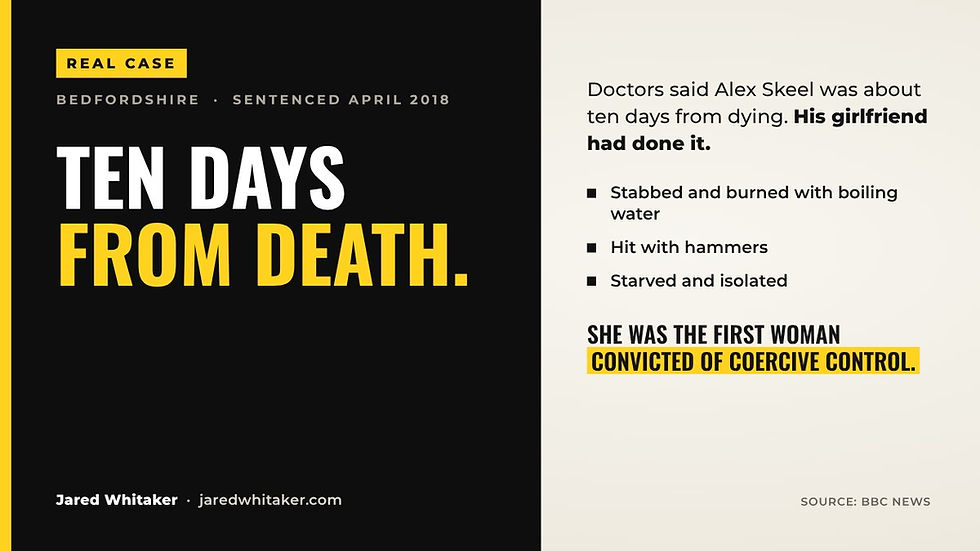
Inside was Alex Skeel, 22. He had injuries to his hands, and burns to his arms and legs. He was taken to hospital.
Then he went home, back to the girlfriend who had done it.
It was only when a police officer persuaded him to tell the truth that the full picture came out. Doctors told him he was about ten days from death. He had lost three stone, and he had infected burns over much of his body.
They had met when they were both 16. The mental abuse went on for around four years. In the last nine months or so, it turned physically violent.
She stabbed him. She threw boiling water over him. She hit him over the head with a bottle, then chased him and hit his hands and face with a hammer. She stopped him eating and made him sleep on the floor. She kept him away from his family.
Once she told him his grandfather had died. It wasn’t true. He cried for about two hours, and then she berated him for caring about his family.
In April 2018, at Luton Crown Court, she pleaded guilty to grievous bodily harm with intent and to controlling or coercive behaviour. She was jailed for seven and a half years. Police said it was the first time a woman had been convicted of coercive control in the UK.
Read the middle part again. He got out, he was taken to hospital, and he went back.
That isn’t weakness. It’s what years of control does to someone. It takes away your sense of what’s normal, cuts you off from anyone who might tell you otherwise, and makes going back feel safer than leaving. It took a neighbour, then a police officer who didn’t take his first answer, before he could say it out loud.
The detective on the case put it simply: coercive control is subtle, and it isn’t always obvious what’s been happening.
Alex has since spoken publicly about what happened, including in the BBC Three documentary Abused By My Girlfriend, and he now works as an ambassador for the ManKind Initiative. He has said he believes he survived to help others going through the same thing, and he urges anyone in that situation to ask for help.
So if you’re a neighbour, a friend, a colleague or a police officer: don’t stop at the first “I’m fine.”
This is why I write. Not because these cases are rare, but because almost nobody talks about them.
If this is happening to you, the ManKind Initiative helpline is free on 0808 800 1170, weekdays 10am to 4pm. If you’re in danger, call 999.


Comments